
Grant County Arrest Records and Court Charges
Arrest records in Grant County are tied to the agency that made or received the arrest and to the booking process at the Grant County Law Enforcement Center. The sheriff's office is at 210 E. Central Avenue, Ulysses, KS 67880, phone 620.356.3500. The county identifies James Biddle as sheriff and says the sheriff's office operates the Grant County Jail, serves District Court processes, handles offender registry responsibilities, provides fingerprinting, and performs vehicle identification number inspections. Those duties make the sheriff the practical first contact for booking, custody, and arrest-record routing.
Court charge records are different. Once law enforcement refers a case, the Grant County County Attorney decides what criminal charges to file. The County Attorney is Kelly Premer Chavez, with an office at P.O. Box 967, 108 S. Main, Ulysses, Kansas 67880, phone 620.356.3155. The county lists prosecution of crimes referred by law-enforcement agencies, appellate litigation, investigation support, and drafting subpoenas or search warrants among that office's duties. Filed criminal charges then move through the District Court and the Clerk of the District Court.
The Grant County Sheriff source is the first official county source for the arrest side of the record.
The sheriff source is useful for identifying the law-enforcement office, but it should not be read as a court charge index.
Booking Charges vs Filed Charges
A booking charge is the description attached to the arrest or jail intake. It can reflect the officer's referral, an arrest warrant, a citation, or a preliminary statute reference. A filed charge is the allegation placed into a District Court case by a prosecutor through a complaint, information, citation, or other charging document. Those two labels can match, but they do not have to match. A booking entry may be broader than the filed case, and a filed case may include additional, fewer, or different counts after review by the County Attorney.
| Record Point | Primary Source | What It Usually Shows | Best Use |
|---|---|---|---|
| Arrest or booking | Sheriff / jail | Name, arrest date, booking status, preliminary charge, custody, bond if public | Confirm custody or recent arrest information |
| Filed court charge | Clerk of the District Court / CaseSearch | Case number, charge count, statute or citation, filing date, charge status | Confirm what the prosecutor filed in court |
| Case outcome | District Court criminal case file | Plea, dismissal, conviction, sentence, probation, fines, costs, restitution | Distinguish accusation from final disposition |
For current custody and jail visitation rules, use inmate records. For the broader criminal case file, including motions, hearings, judgments, and sentencing, use criminal court records. For all public district case categories, use court records.
How to Find Grant County Arrest Records and Charges
Grant County does not publish a separate county-built online arrest-charge database in the official sources reviewed. The charge lookup path starts with the Kansas Judicial Branch public district court tools and continues with the Clerk of the District Court at 108 S. Glenn, Second Level, Ulysses, KS 67880, phone (620) 356-1526. Kansas Courts says public district court case information and case records can be searched online through Kansas CaseSearch or through courthouse terminals. The public portal may show public criminal case information and documents, while restricted, sealed, juvenile, and expunged material may be withheld.
- Check Kansas CaseSearch for the defendant name, case number, business name, or citation number if known.
- Use Grant County District Court as the court context and compare any result to the known arrest date or citation information.
- Open the public case record and review the charge list, docket events, bond orders, warrants, plea entries, and disposition entries that are visible.
- Call the Clerk of the District Court at (620) 356-1526 when the case number, charge wording, certified-copy status, or public-access limit is unclear.
- Call the sheriff's office at 620.356.3500 when the question is booking, jail custody, arrest report routing, or bond information rather than the filed court charge.
The KBI registered offender source is useful for offender-registration context after certain convictions.
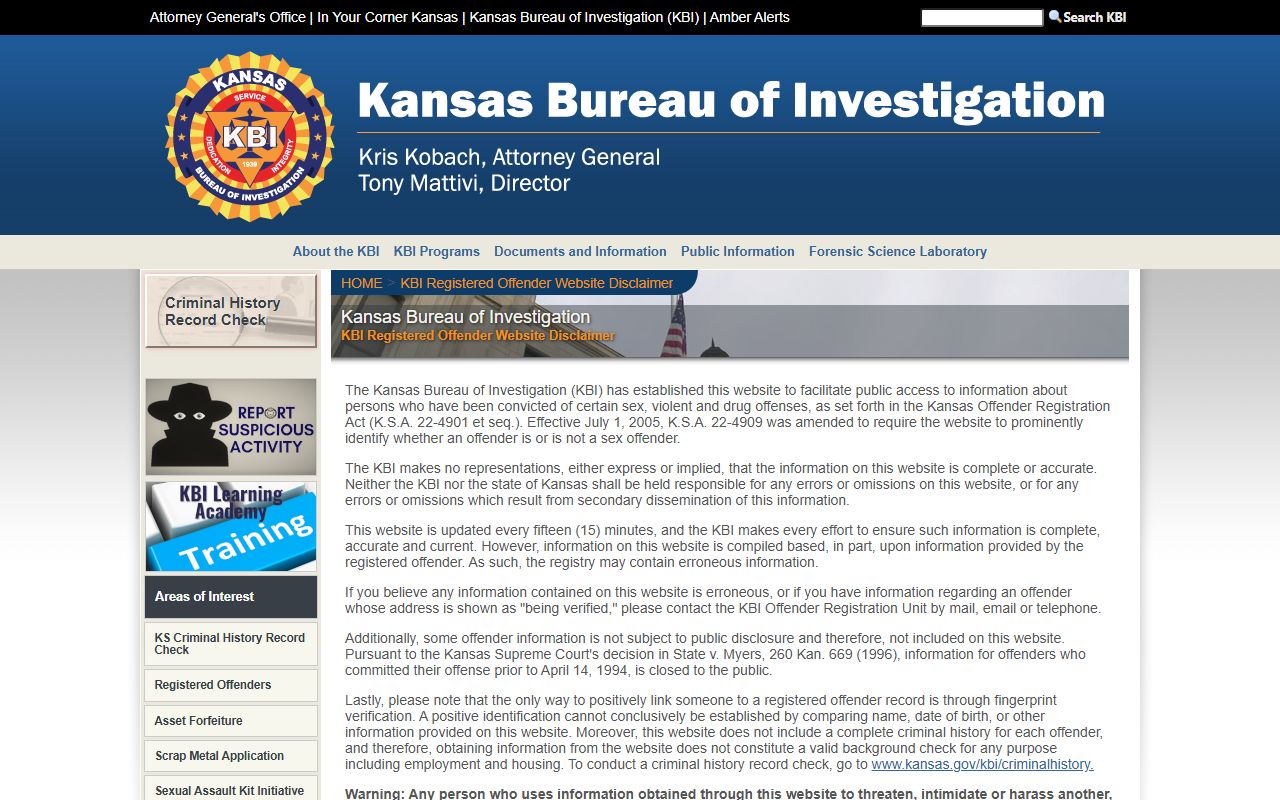
Offender-registry and state-supervision tools can add context, but they do not replace the Grant County court charge record.
Charging Documents After Arrest
The formal charge record usually begins when a charging document is filed. In Kansas district court practice, public criminal records may include a complaint, information, citation, amended complaint, warrant entry, bond order, docket event, plea document, order, judgment, or sentencing entry. The research glossary identifies a complaint as a written pleading that starts a civil case or states a criminal charge, and an information as a formal criminal charging document filed by a prosecutor. A citation may state a traffic or ordinance violation and can become the charge record for lower-level matters.
| Document | Filed By | Common Grant County Use | Where to Check |
|---|---|---|---|
| Complaint | Prosecutor or officer-supported filing | States the criminal allegation and count information | District Court file or CaseSearch if public |
| Information | County Attorney | Formal prosecutor-filed charging document, often after review | Clerk of the District Court |
| Citation | Law enforcement | Traffic, fish/game, or ordinance-style allegations | District Court or Ulysses Municipal Court, depending on location |
| Amended charge | County Attorney or court-approved filing | Changes count wording, statute, severity, or number of counts | Docket events and filed documents |
Charge Status and What It Means
Charge status can change repeatedly between arrest and final judgment. A charge may be pending after filing, amended after plea negotiations or evidentiary review, dismissed before or after another count is resolved, or closed by conviction, acquittal, diversion, or sentence. A single Grant County arrest can produce several counts, and each count can have a different status. Read the docket event index and the final judgment together before treating a listed charge as the current outcome.
| Status | What It Means | Record Note |
|---|---|---|
| Pending | The accusation is filed and unresolved. | Future hearings, bond conditions, or motions may still appear. |
| Amended / Reduced | The charge wording, severity, statute, or count changed. | Compare the original count to the amended filing and judgment. |
| Dismissed | The count was ended without conviction on that count. | Check whether dismissal was with or without prejudice and whether other counts remain. |
| Diversion | A prosecutor-approved program may avoid conviction if completed. | Terms and completion status may be limited or shown as docket events. |
| Convicted | A guilty plea, no-contest plea accepted as a conviction, or trial verdict established guilt. | Use the judgment and sentence entry for final detail. |
Charges vs Convictions
Being charged is not the same as being convicted. A charge is an accusation placed in the court record. A conviction is a final criminal outcome after a plea or verdict. Kansas public records may show both, but a public user should avoid treating the arrest or initial complaint as proof of guilt. Grant County criminal case files can also show dismissed counts, amended counts, diversion, probation, restitution, fines, court costs, and sentence conditions.
| Charge | Conviction | |
|---|---|---|
| Stage | Accusation after arrest or citation | Final guilt finding by plea or verdict |
| Source | Complaint, information, citation, warrant, docket entry | Judgment, plea entry, sentencing order |
| Can change? | Yes, it may be amended, reduced, or dismissed | It may be appealed, corrected, expunged, or otherwise modified only through legal process |
| Public record? | Often public unless restricted | Often public unless restricted or expunged |
Sealed and Expunged Charge Records
Kansas public access is broad, but it is not unlimited. Juvenile records, adoption records, mental-health proceedings, protected personal identifiers, criminal investigation records, sealed files, and expunged records can be restricted. Adult expungement is governed by K.S.A. 21-6614, and the research notes that a Grant County adult expungement is filed in the court with jurisdiction over the event. For a District Court criminal case, that means the Clerk of the District Court on the second level of the courthouse. Juvenile expungement is handled under K.S.A. 38-2312.
| Sealed | Expunged | |
|---|---|---|
| Visibility | Closed from ordinary public access by law or court order | Public access and dissemination are limited after a granted petition |
| How it happens | Statute, rule, or judge's order | Petition and court order under Kansas expungement law |
| Agency follow-up | Access may remain for authorized court or law-enforcement purposes | If granted, the clerk sends a certified order to KBI for processing |
Statewide Charge and Offender Lookups
The Kansas Bureau of Investigation and Kansas Department of Corrections provide statewide tools, but neither is a substitute for the Grant County filed court charge. KBI criminal-history products are separate from the court docket. The KBI Registered Offender Registry publishes sex, violent, and drug offender information under the Kansas Offender Registration Act and is updated every 15 minutes, but KBI warns that registry information may be incomplete or inaccurate because some data depends on offender reporting. KDOC KASPER covers persons and cases associated with KDOC-funded or KDOC-operated programs and is not a complete criminal history.
The Grant County sheriff staff source identifies local law-enforcement staffing and jail operations related to arrest and booking workflows.
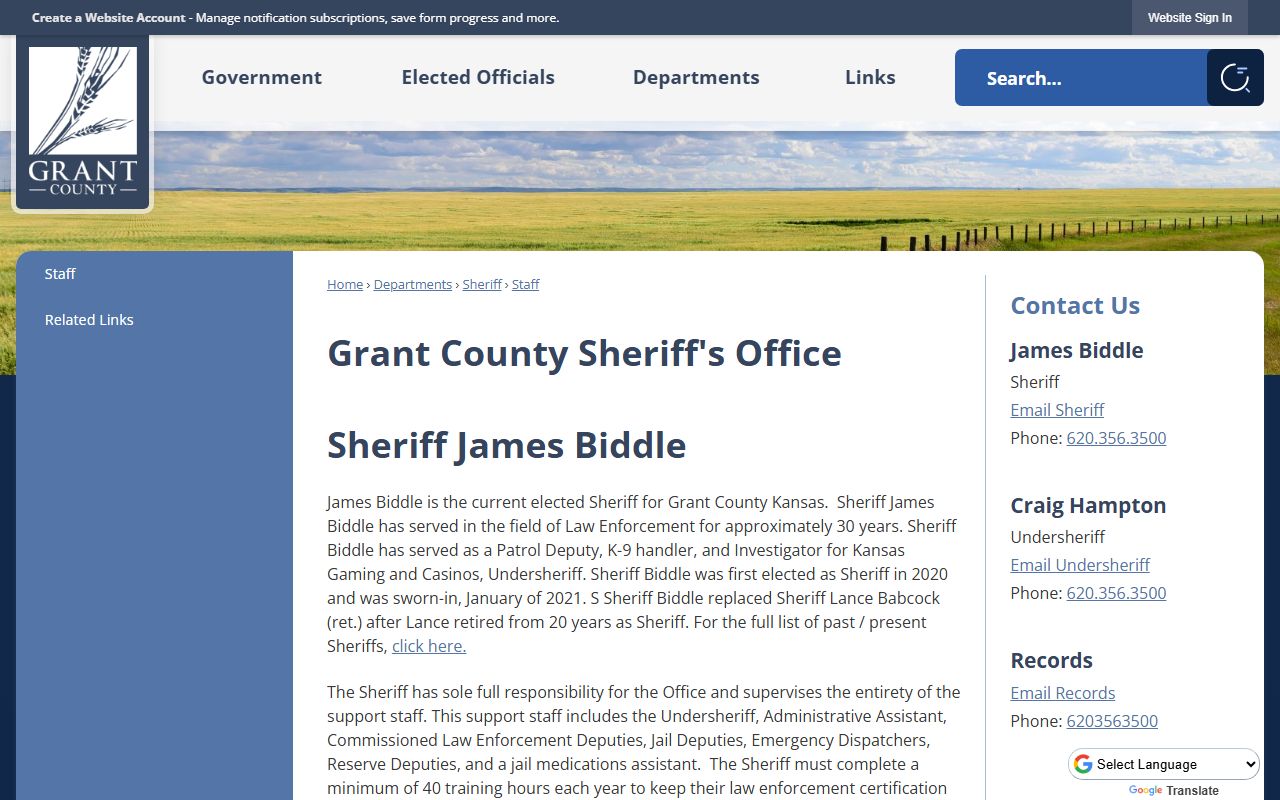
Those local staffing details support booking-record routing, while filed charges remain a court and prosecutor record.
The KDOC KASPER disclaimer is relevant when an arrest or conviction has moved into state custody or supervision.
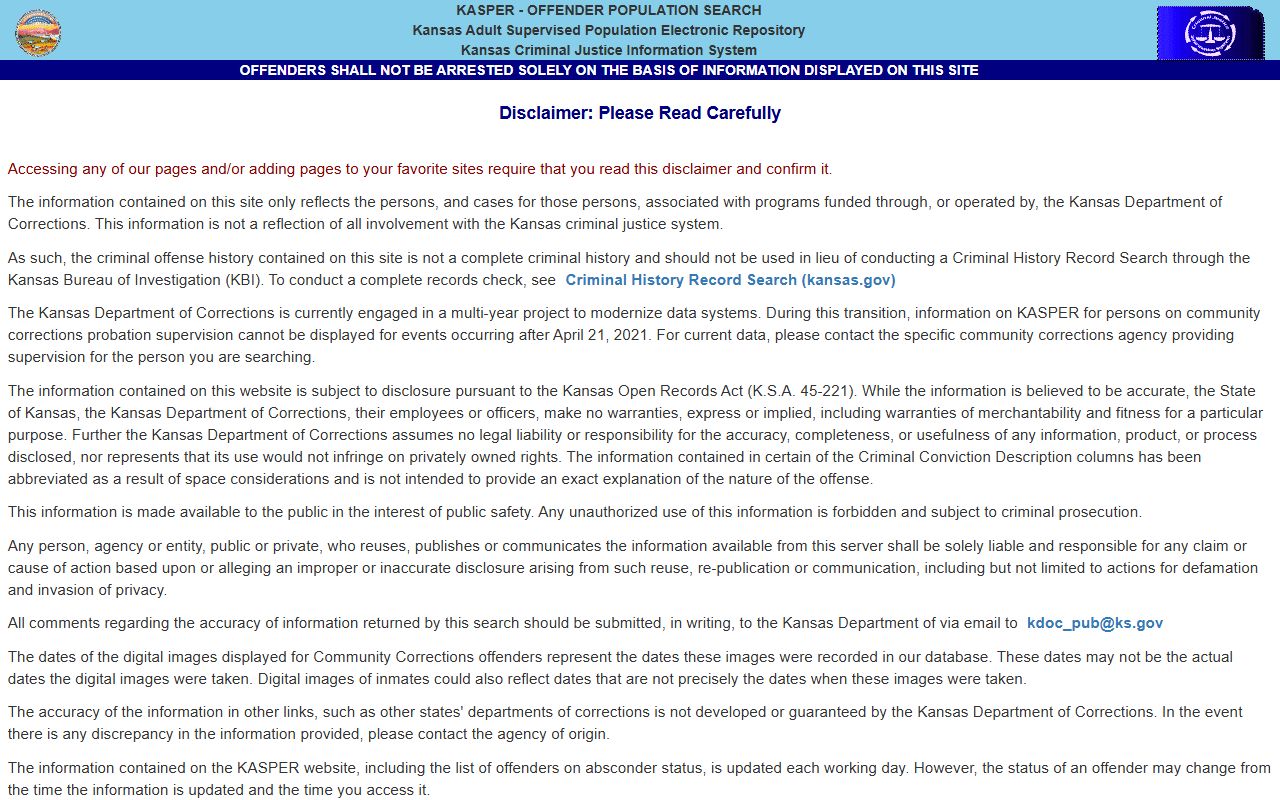
KASPER can show custody or supervision fields, but it should not be used as a Grant County arrest-record or warrant list.
Restricted Charge Records in Grant County
Kansas Supreme Court Rule 22 and Rule 106B allow public access to district court case records and event indexes through courthouse terminals and remote public access, subject to restrictions. Public records can redact Social Security numbers, financial-account numbers, protected addresses, medical information, minor names, sealed orders, and confidential juvenile or adoption content. Grant County's Freedom of Information material also identifies criminal investigation records as a KORA exception. If the charge arose from an ongoing investigation, a juvenile matter, a sealed warrant, or an expunged case, the public record may show less than the person expects or may not appear at all.
Important: Court and arrest information should be verified with the originating office before use for any official decision.