
Grant County Criminal Court Cases
Criminal cases in Grant County District Court begin after law enforcement refers an investigation and the County Attorney files or pursues charges in court. The Grant County County Attorney is Kelly Premer Chavez. The county attorney's office duties include prosecuting crimes referred by law-enforcement agencies, appellate litigation, aiding law enforcement in investigations, and drafting subpoenas or search warrants. Once a case opens, the Clerk of the District Court keeps the court file and docket.
The Grant County County Attorney page is the local source for the prosecution role in criminal court records.
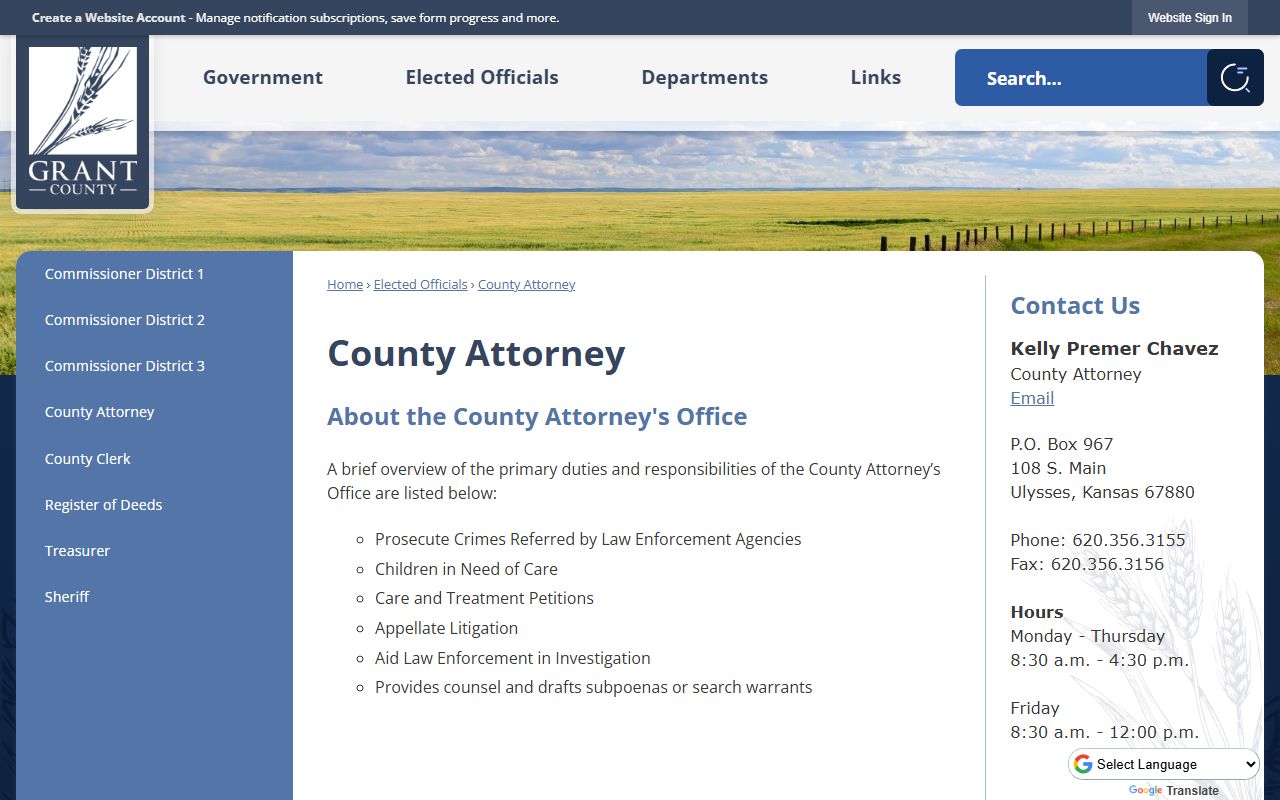
The prosecutor's filing decision is part of the path from investigation to a court case, but the criminal court record itself is maintained through the District Court.
Grant County District Court has general original jurisdiction over criminal and civil cases. Ulysses Municipal Court is separate and handles violations of City of Ulysses ordinances, including many city traffic and ordinance matters. A person checking a city ordinance case may need Ulysses Municipal Court, while a felony, most state misdemeanor filings, and county-level criminal matters route through District Court.
Search Grant County Criminal Records
The main online path for public Grant County criminal court records is Kansas CaseSearch. Search by case number if it is known. If not, search by defendant name and then check the case type, county, court, status, and docket events before relying on a match. Criminal cases can involve common names, aliases, amended charges, sealed entries, and post-disposition activity, so a name match alone is not enough.
The Kansas Bureau of Investigation offers statewide criminal-history and registry resources, but those do not replace a Grant County criminal court case file.
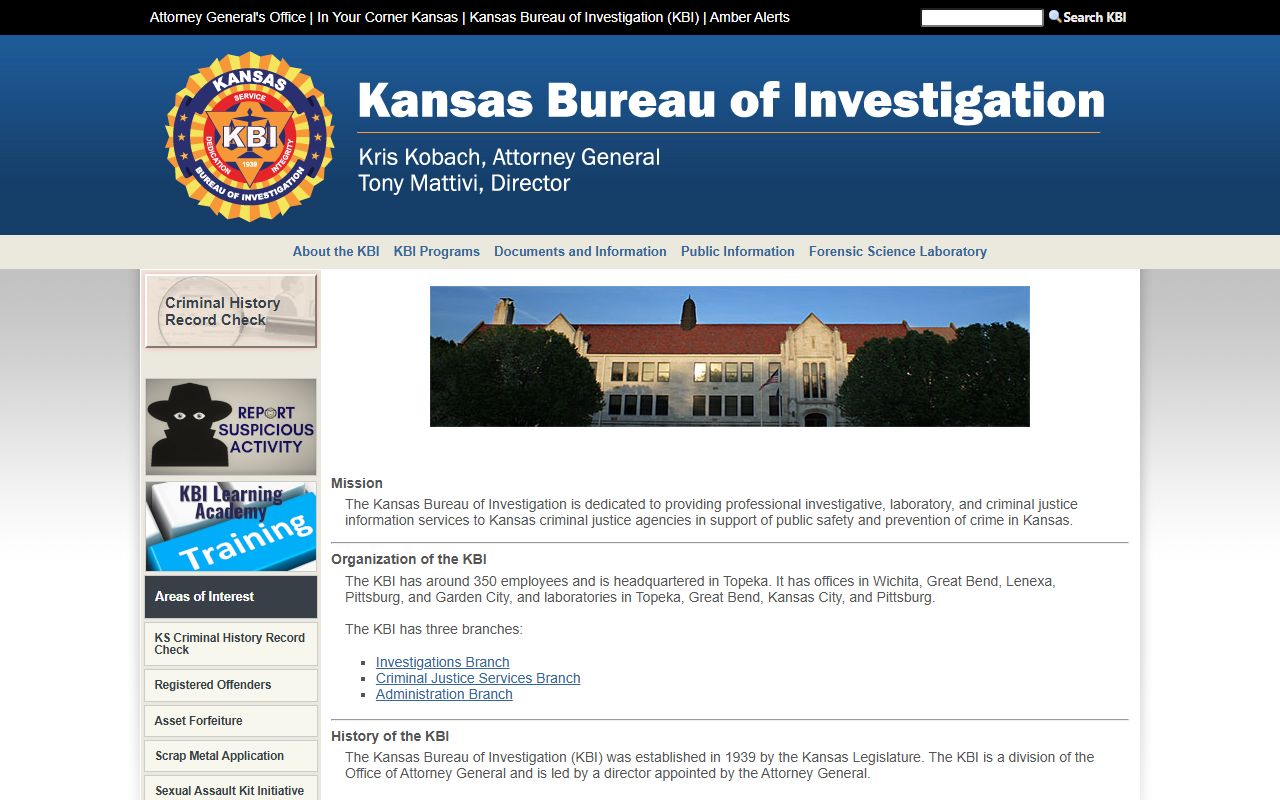
KBI resources can help with statewide criminal-history context, while Kansas CaseSearch and the Clerk of the District Court remain the court-record channels for Grant County cases.
- Open Kansas CaseSearch and search by case number when the number is available.
- Search by defendant name when the case number is not known, then compare county, case type, and filing date.
- Open the case result and read the docket events for charges, appearances, pleas, motions, warrants, disposition, and sentencing.
- Check whether the case includes public documents online or only docket entries.
- Contact the Clerk of the District Court for certified copies, older files, courthouse-terminal access, or restricted-record questions.
Grant County Criminal Case Flow
A criminal court record changes as the case moves. A first entry may show a complaint or information filed. Later entries may show a first appearance, bond order, arraignment, motions, hearing settings, subpoenas, plea, trial, verdict, dismissal, diversion, disposition, sentence, probation, fines, costs, restitution, or warrant events. Each stage may create a docket entry, a filed document, or both.
Case flow: Charges Filed › Arraignment › Pretrial / Motions › Plea or Trial › Disposition › Sentencing
| Stage | What Happens |
|---|---|
| Charges Filed | The prosecutor files a complaint or information, and the court opens the criminal case. |
| Arraignment | The defendant appears, the charges are addressed, and a plea may be entered. |
| Pretrial / Motions | The court handles bond, discovery, subpoenas, continuances, motions, and hearing settings. |
| Plea or Trial | The case may resolve by plea, diversion, dismissal, bench trial, or jury trial. |
| Disposition | The docket records the outcome of each charge or the case as a whole. |
| Sentencing | The court enters jail or prison terms, probation, fines, costs, restitution, or other conditions when conviction occurs. |
Grant County Criminal Record Fields
A Grant County criminal court record may contain more than one layer of information. The case header identifies the court, county, case number, parties, and status. The charge section identifies each filed charge, statute, severity level where available, and charge status. The docket or events index shows the case path. The document file may include complaints, bond orders, warrants, motions, plea papers, journal entries, sentencing orders, and probation terms when public access is allowed.
| Field | What It Shows |
|---|---|
| Case Number | The unique criminal case identifier used by Kansas CaseSearch and the Clerk of the District Court. |
| Defendant | The person charged in the case, subject to redaction or limits where law requires. |
| Charges | The filed accusations, statutes, counts, and any amendments or dismissals shown in the case. |
| Bond / Warrant Events | Release conditions, bond activity, bench warrants, arrest warrants, or recall events where public. |
| Plea | Guilty, not guilty, no contest, diversion-related entries, or other plea status shown by the docket. |
| Motions and Hearings | Requests to the court, hearing dates, continuances, notices, and court rulings. |
| Disposition | Dismissed, amended, acquitted, convicted, diverted, closed, or otherwise resolved. |
| Sentence | Jail, prison, probation, fines, court costs, restitution, treatment conditions, or other ordered terms. |
Charges vs Convictions
A charge is an accusation filed in court. A conviction is an outcome after a guilty plea, no-contest plea accepted as a conviction, or finding of guilt. Grant County criminal court records can show charges that were filed but later amended, reduced, dismissed, diverted, or ended in acquittal. For deeper detail about the filed charge path after an arrest, use the Grant County arrest records and court charges page.
| Charge | Conviction | |
|---|---|---|
| Meaning | A formal accusation filed in court. | A finding or plea establishing guilt. |
| Timing | Appears near the start of the criminal court case. | Appears after plea, trial, or other final outcome. |
| Can Change | May be amended, reduced, dismissed, or replaced. | May be appealed, expunged if eligible, or modified by later court order. |
| Record Use | Shows what was alleged by the state. | Shows the adjudicated outcome and sentence basis. |
Grant County Defense Records
Criminal court dockets can also show defense-related events, including appointment of counsel, motions, subpoenas, continuances, plea settings, and hearing outcomes. Kansas public defense is handled through the Kansas State Board of Indigents' Defense Services, or BIDS, using public defender offices or assigned counsel. For Grant County defendants, appointment of counsel is handled through the court process rather than as a substitute for appearing in court.
The Kansas BIDS website is the statewide source for public defense structure.

BIDS context can explain how counsel may appear in a docket, but the public criminal court record remains with the court clerk.
The BIDS contact information resource lists the Western Regional Public Defender Office in Garden City for regional public defense contact details.

Public defender contact details do not replace court notices, bond orders, or hearing dates shown in the Grant County criminal court docket.
Sealed vs Expunged Records
Restricted criminal records are not all the same. A sealed record is closed from ordinary public view by law or court order. An expunged record is limited through a statutory court process that can restrict public access to an eligible conviction, arrest record, or diversion agreement. Kansas adult expungement is governed by K.S.A. 21-6614. Juvenile expungement is handled separately under Kansas juvenile law.
The Kansas adult expungement statute is one source assigned to Grant County criminal court records.
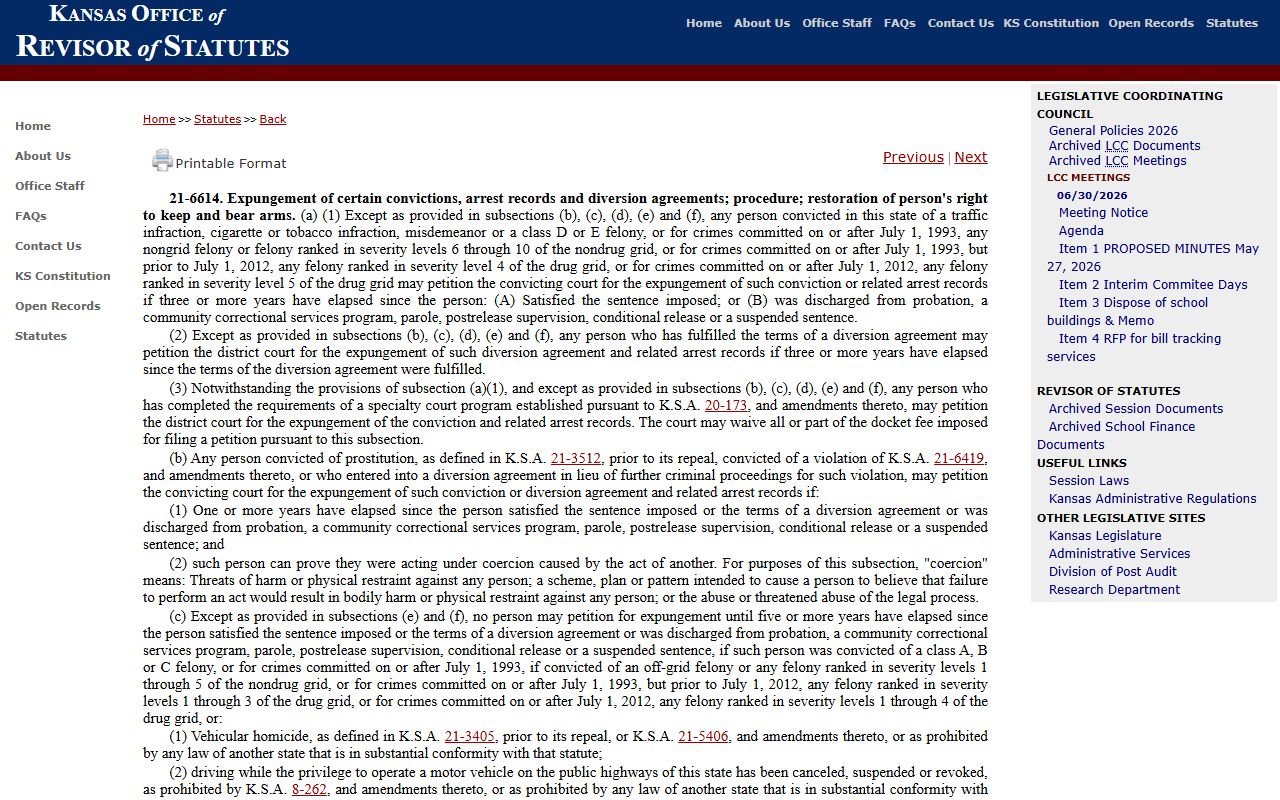
Adult expungement starts with a petition in the court with jurisdiction over the event, which for a Grant County District Court criminal case means the local District Court.
| Sealed | Expunged | |
|---|---|---|
| Public View | Closed or limited by rule, law, or court order. | Public access is limited after a granted petition under Kansas law. |
| How It Happens | May occur by statute, case type, or judge's order. | Requires eligibility review and a petition process. |
| Examples | Juvenile, adoption, protected personal data, some mental-health, and sealed orders. | Eligible adult convictions, arrest records, or diversion agreements under K.S.A. 21-6614. |
| Agency Notice | Depends on the sealing order and record type. | If granted, the clerk sends a certified order to KBI for processing. |
Grant County Juvenile Limits
Grant County District Court handles juvenile matters, but juvenile records are restricted and should not be treated as ordinary public criminal court records. Kansas juvenile expungement uses a separate statute, K.S.A. 38-2312. A juvenile record may have different eligibility rules, docket-fee rules, and disclosure limits from an adult criminal case.
The Kansas juvenile expungement statute is assigned as a Grant County criminal court records source because juvenile restrictions are central to public-access boundaries.
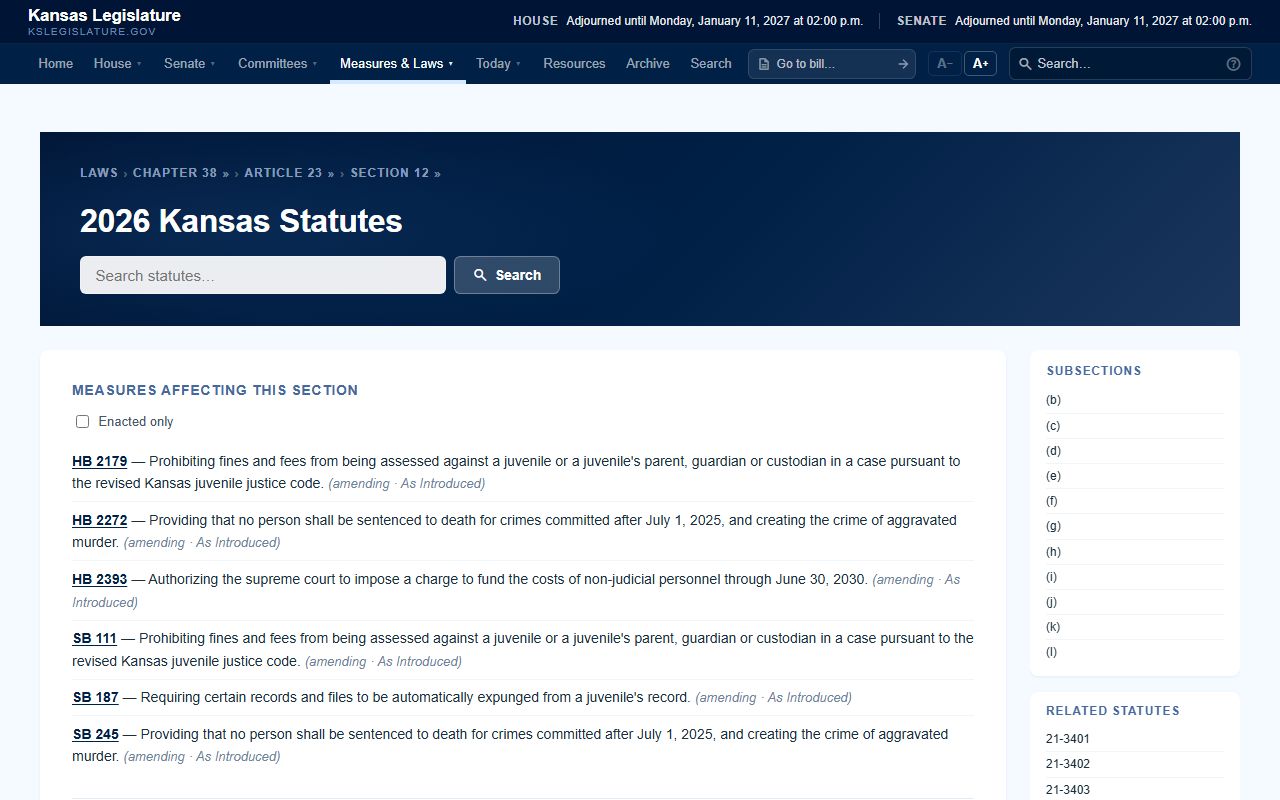
When a search returns no juvenile information, the absence may reflect legal limits rather than proof that no juvenile proceeding ever existed.
Grant County Criminal Record Access
Public access to Grant County criminal court records comes from both general Kansas public-record policy and court-specific rules. K.S.A. 45-215 states the Kansas policy favoring inspection of public records unless a law closes them. K.S.A. 45-221 lists records not required to be disclosed, including criminal investigation records and other exempt categories. Court records also operate under Kansas Supreme Court Rules 22, 106B, and 108.
For a court case, the practical access points are Kansas CaseSearch, the courthouse terminal, and the Clerk of the District Court. For law-enforcement incident records, jail booking questions, and sheriff process questions, the Grant County Sheriff's Office may be the right contact. For the full criminal court case record, the Clerk of the District Court is still the record custodian.
Key Statutes:
K.S.A. 45-215 states Kansas public-record policy.
K.S.A. 45-221 lists exemptions, including criminal investigation records.
Criminal History vs Court Case
A Grant County criminal court record is not the same as a full statewide criminal-history check. A court record follows one case in one court. A statewide criminal-history product may pull from broader state repositories and may be subject to different laws, fees, identifiers, and permitted uses. KASPER, the Kansas Adult Supervised Population Electronic Repository, is also not a complete criminal history; KDOC says it reflects persons and cases associated with programs funded through or operated by KDOC.
For employment, tenant screening, credit, insurance, or other regulated decisions, use a legally compliant background-check process rather than a casual case lookup. Court records can be useful for public inspection and personal research, but regulated decisions have separate notice, consent, accuracy, and dispute rules.
Important: A public case lookup is not an FCRA consumer report and should not be used as one.
Restricted Grant County Criminal Records
Some Grant County criminal court records are public, some are partly public, and some are closed. Restricted categories include juvenile records, sealed matters, expunged records, protected personal identifiers, confidential addresses, medical information, and records tied to statutory confidentiality. Criminal investigation records may also be exempt under Kansas open-records law even when a related court docket is public.
For a certified criminal court record, contact the Clerk of the District Court at 108 S. Glenn, Second Level, Ulysses, KS 67880, phone (620) 356-1526. Bring or provide the case number, defendant name, date range, document requested, and photo identification if asked. For active warrants, jail status, or custody questions, the Grant County warrant records and sheriff channels may be more direct, but they do not replace the criminal court case file.